Safeguards and monitoring
What watches the system
The failures that cost the most in trading software are the quiet ones — a feed that stopped updating, a record that was half-written, a limit that was switched off months ago, a number that reads as zero because nobody could measure it. Most of this project's machinery exists to make those failures loud.
This page is the inventory: what the system refuses to do on a guess, how it keeps what it writes intact, where every action is recorded, how it diagnoses itself, what watches it while it runs, and how it tells you the truth when the truth is inconvenient. The order-level controls — the gates, limits and stops around anything that can place a trade — have their own inventory on the Live page, and are not repeated here.
| Program | What it watches |
|---|---|
| The Mithraeum | Its own data, its own orders, every job it runs, and the honesty of every search — and it diagnoses itself daily. |
| The Agora | Sign-in events, sessions, device links and support conversations. It has no market data to watch, by construction. |
| The Control Plane | Its own operator trail, chained so an edit is detectable, and every request its gate refused, counted by reason. |
| The workbench | The other three: whether they are running, what their history looks like at three in the morning, what should not be running at all, and whether the backups would actually restore. |
Refusing rather than guessing
6 refusalsEvery default here fails closed. When the system does not know, it does not act — and it says which thing it did not know.
One data source and no fallback to anotherrefusal
Every market-data request goes to the source you selected and to no other. A source the application does not recognise requests nothing at all rather than quietly routing to whichever vendor happens to be configured.
Guards against: data arriving from somewhere you did not choose, under terms you did not agree to, and a backtest that silently changed source halfway through its history.
An unverified update surfaces nothingrefusal
The release feed is signed, and the application verifies it against a key it pinned earlier. A feed that fails verification shows no version, no link and no checksum — and a new signing key can only arrive through a different channel from the one serving the feed, so an update host can never vouch for itself.
Guards against: a tampered feed steering you to a download, which works precisely because it looks like a routine notification.
An unclassified service door is closedrefusal
The Control Plane's routes are sorted into public, service and operator scopes by one explicit map, and anything the map does not name defaults to the most restricted scope. Adding a new door never makes it public by omission.
Guards against: the most common way a backend leaks — a new endpoint shipped before anyone decided who may call it.
A protective order it cannot price is not sentrefusal
A stop with no price reference of any kind is refused rather than placed at a guess. A safeguard that places an order on an assumption is not a safeguard — and every order the system places on its own traces back to something the user configured.
Guards against: an automatic protection creating the very loss it was meant to prevent.
A stale input holds the orders it feedsrefusal
A deployment whose logic reads a second series pauses its orders the moment that series is stale or missing at the current bar, and says which series and why. It resumes when the data does.
Guards against: trading on an unknown input — a condition evaluated against a price that stopped arriving, which reads exactly like a quiet market.
An estimate it cannot make prints nothingrefusal
A preflight that cannot count what a job will cost shows no number rather than zero; a noise floor that was never measured is labelled unfloored rather than omitted; a figure computed from too few observations carries its sample size beside it.
Guards against: "this is free" and "this is fine" being read off a measurement that never happened.
Integrity of what is written
4 mechanismsEvery store write is atomic, per writerintegrity
Each write goes to its own temporary file and replaces the store in one step, and every read-modify-write holds the store's lock for the whole operation. This was learned the expensive way: two concurrent writes once shared one fixed temporary name, spliced a store together, and forty saved strategies were gone by the afternoon.
Guards against: a store that is half one write and half another, which is worse than either — it parses, so nothing notices.
A file that will not parse is kept, not replacedintegrity
A corrupt store is set aside under a timestamped name and reported, never overwritten with an empty one. Corrupt and missing are different facts, and treating them as the same is how a recoverable accident becomes a permanent one.
Guards against: the recovery path destroying the only evidence of what was there.
A record's number is never reusedintegrity
Records are addressed by number from several places at once — the current selection, portfolio legs, starred conditions, stress history. The counter never rewinds, so deleting a record can never hand its number to an unrelated one.
Guards against: a pointer that silently re-binds to a different strategy after a delete, which looks like the right record with the wrong contents.
Backups that are checked, not just takenintegrity
Snapshots are scheduled by the age of the newest archive rather than a clock, each carries a checksum, and an archive without one is reported as unverifiable. The backup set is audited against the list of stores that must never be lost — an audit that has found whole directories missing from it before. Restoring is deliberately a command, not a button, and it refuses to write over a live tree.
Guards against: discovering that the backup was incomplete on the day you need it.
Trails — where every action is written down
5 trailsThe audit trail is append-only and hash-chainedtrail
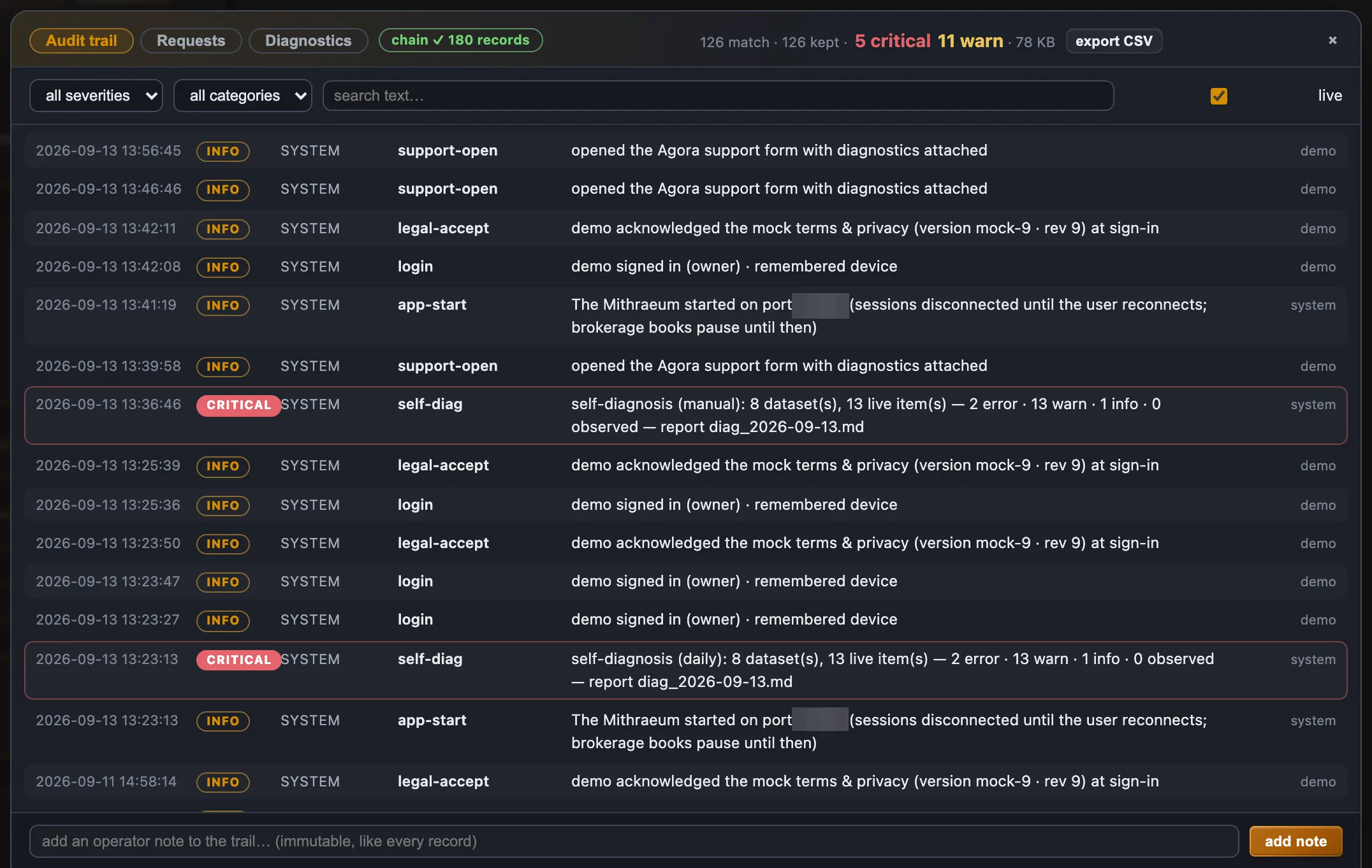
Every order, connection, deployment, risk event and configuration change is written to an append-only trail in which each record carries a hash of the one before it. The logging window shows the chain's integrity on every read — any edit, deletion or reordering breaks it and says where — with category filters, text search, a live poll and a CSV export of the filtered view.
It is local and never transmitted. The legal terms name it as something the operator of the online services never holds.
Guards against: a history that can be quietly corrected after the fact, which is no history at all.
The Control Plane's own trail is chained tootrail
Every operator act — conferring a tier, rotating a key, publishing a release — is recorded in the same chained form and verified every time it is read. A request its gate refused is counted, not recorded: an unauthenticated caller must never be able to grow the operator's own record.
Guards against: the commercial authority's history being editable by the people it records, and a stranger filling it with noise.
Every request, in one trailtrail
Brokerage and market data together: what was asked for, what actually crossed the wire, and what came back — a single fetch shown beside the individual requests it became. A summary of each can be mirrored into the audit trail so it survives beside the orders it fed.
Guards against: traffic nobody can account for, and "the data was wrong" with no record of what was asked.
Decision ledgers for everything that acts on its owntrail
Every standing rule keeps a fire ledger — including the rules in shadow mode, which record exactly what they would have done. Every research bot keeps a ledger of every decision it took and the reason, including every coercion of its configuration and every advisory it was given at deployment.
Guards against: automation whose behaviour can only be inferred from its results.
The end-of-day digest is one immutable recordtrail
A day's summary can be written into the trail as a single record, so a day that has been reviewed stays reviewed — the digest cannot be regenerated later into something different.
Guards against: a summary that changes each time it is recomputed from data that has since moved.
Diagnostics — the system examining itself
4 diagnosticsA daily self-diagnosis, in two formsdiagnostic
The application diagnoses itself: one engine feeds both the warning panel you see while working and a daily report written in two forms — one for a person to read and one for a program to consume. Severity is honest in both directions: an empty data store is not "all clear", and a session that is closed at midnight is not an incident.
Guards against: two diagnoses of the same system disagreeing, because they were computed by two different engines.
The data-quality sentinel reads every stored seriesdiagnostic
It scans every dataset for ordering, price, split, volume, staleness and interior-gap defects and writes a dated report you can open from the logging window, or run on demand.
Guards against: an unadjusted split or a run of fabricated bars that flatters every backtest run over it.
The support bundle is built through an allowlistdiagnostic
When you ask for help, the diagnostic bundle is assembled field by field from a declared list — build identity, platform, configuration flags, counts and error types — and a field nobody declared is dropped, never sanitised. Exception messages are discarded outright, because a language runtime interpolates values into them. The whole bundle is shown to you as text before anything is sent.
Guards against: a help request that carries a position, a symbol or an account number off your machine by accident.
The workbench's sweep reads the verdict, never re-derives itdiagnostic
The workbench adds only the facts it owns — whether the application is reachable, how things are trending — to the application's own verdict, and keeps a ticket for each finding: critical when it is new or has come back, standing when it is known, resolved automatically when it has been absent for a day.
Guards against: a second opinion computed a different way that slowly drifts from the first, until the two disagree about whether anything is wrong.

Monitoring — what watches it while it runs
6 monitorsAlerts come from the trail, not beside itmonitor
Fills, rejects, disconnects, risk events and data events are derived from the audit trail rather than kept as a second record, so the alert you were shown and the record of what happened can never disagree. The badge turns red on an unseen error.
Guards against: a notification system with its own idea of what happened.
The headless monitor is a second screen that cannot trademonitor
The live book, the connections, the alerts and the emergency controls — nothing else — on a page that does not depend on the full application being responsive.
Guards against: losing sight of a running book because the main window is busy with something else.
Saying what is working, and what is only latchedmonitor
A slow action shows a turning ring and the present participle rather than a disabled button. A request that only sets a flag — finish the current cycle, stop at the next boundary — is drawn from the state the worker actually obeys, so "stopping" is never shown for a stop that was refused. The clock in the top bar becomes a ring while work runs.
Guards against: a button that looks pressed when nothing happened, and one that looks idle while something is still running.
One admission control for every heavy jobmonitor
Mining, stress sweeps, walk-forwards and every other heavy job pass through one broker that knows what is running and what it may still admit. A person's job pre-empts a research bot's in hundredths of a second, and the server can say at any moment exactly what is running.
Guards against: an unattended search slowing the interactive work of the person it works for.
Background sampling answers "what happened at 3 a.m."monitor
The workbench samples the health of the suite on a cadence, keeps a bounded history and raises threshold alerts. The application appears in it as exactly one fact — whether the process is up — because its stores are not the workbench's to read. A monitoring write may never fail a request.
Guards against: every screen showing the present while nothing remembers the night.
Strays, dependencies and drift are reported, never acted onmonitor
Processes nobody launched are found by where they run, not by their name, and reported rather than killed — an unrecorded process is not provably abandoned. Dependencies are checked against what the interpreter can actually install, not merely against the newest release. And the version of record is derived from the engineering log and compared with what shipped, so a disagreement is shown rather than assumed away.
Guards against: a sixteen-day-old process nobody knew about, an "upgrade available" that can never be performed, and a release number nobody remembered to update.


Warnings that tell the truth
5 warningsHypothetical results are labelled where they appearwarning
Every surface that shows a backtest, a mined strategy, a stress run or a model output carries the standing hypothetical-results language in place, beside the numbers — not in a terms page nobody opens.
Guards against: a simulated figure being read as a track record.
A strategy with no stop is told so firstwarning
The strategy explainer leads with the exits no condition controls — stops, trails, take-profits, time limits — and states plainly when there are none. When it was first run against the saved strategies, more than half had no stop of any kind, and a handful could never trade at all.
Guards against: a logic tree that looks complete while describing a plan the engine does not run.
A search result without its noise floor says sowarning
A mined universe is read against an empirical null — the same search run on tapes with the signal destroyed. Until that floor exists, or once the search settings have moved away from the ones it was measured under, the result is labelled unfloored or stale, and the label says why.
Guards against: admiring the best of a thousand candidates without knowing what the best of a thousand looks like on pure noise.
Advisories and barren stages in the unattended funnelwarning
A research bot is advised at deployment when its configuration will never ask whether a survivor beats simply holding the market. And a funnel stage whose floor rejected every candidate is recorded as barren and refuses to promote anything out of that cycle — "nothing was deleted" is not the same fact as "everything passed".
Guards against: a survivor promoted because every alternative was worse, rather than because it was good.
Findings and gaps are kept separatewarning
The limits sweep reports two different facts: whether your configuration is inside every published limit, and whether something bounds every limit at all. A known gap is not a breach — folding the two together leaves a signal that is always red, and a signal that is always red is not a signal.
Guards against: alarm fatigue hiding the one alarm that mattered.
Limits you cannot switch off
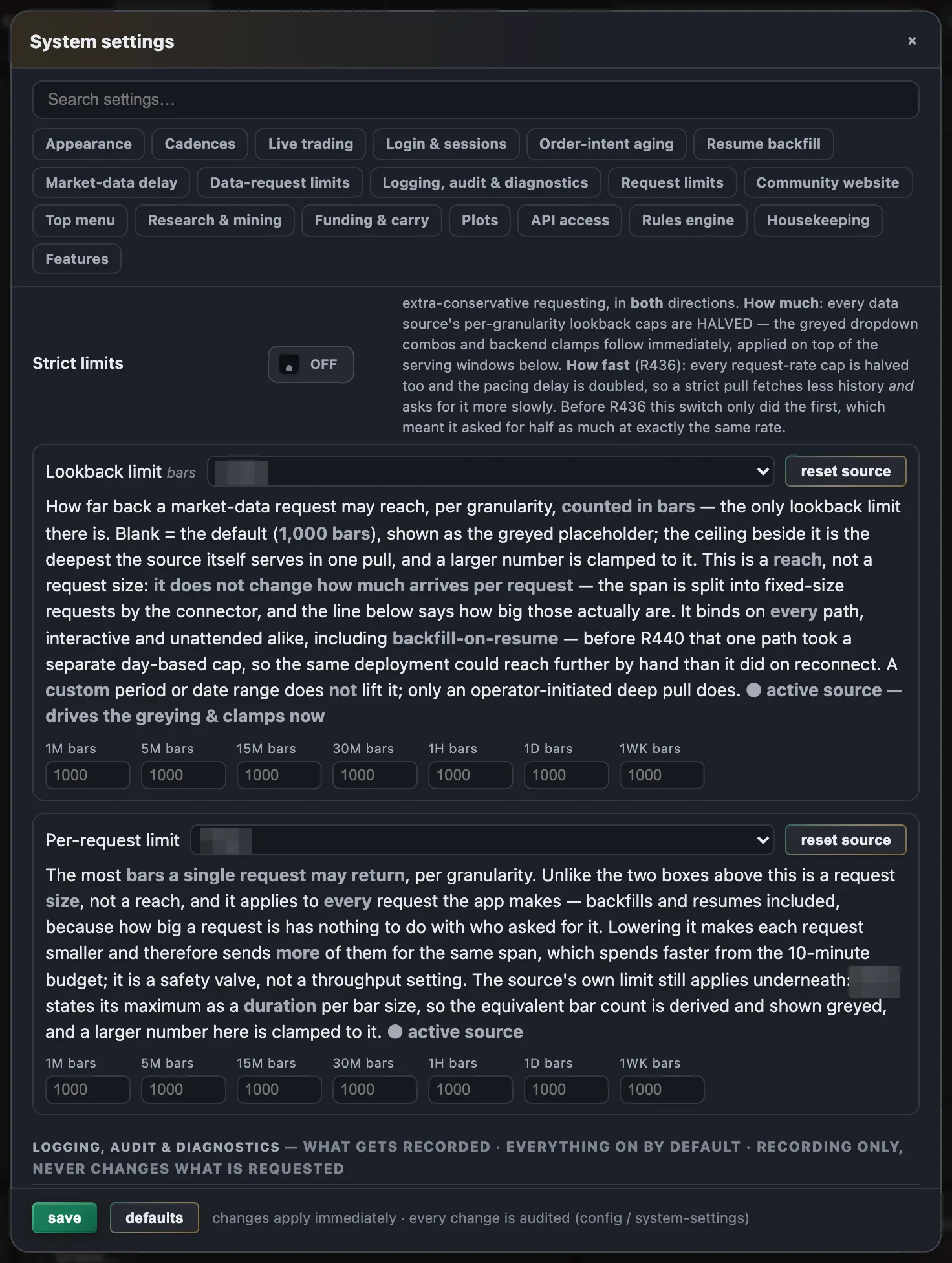
4 limitsA data vendor publishes how fast it may be asked for history, and answers a breach by cutting the service off. Those numbers are treated as facts about the vendor rather than preferences of the user.
A vendor's number is a ceiling, not a defaultlimit
Each governed window has a ceiling — the vendor's last legal value — and a default set deliberately under it. The ceiling is enforced in the one place every settings write passes through, so an edited file cannot step over it either, and a zero on a governed window means the ceiling rather than "off". A limit you can switch off is not a limit.
Guards against: a backfill quietly running at forty times the published rate because a setting was left at zero.
Two published rules, counted separatelylimit
A budget per ten minutes, and a limit on repeated requests for the same instrument in a two-second window — the second one reachable by a single symbol's own history walk while the first is nowhere near its cap. Both are enforced, across every transport to the same account, and survive a restart.
Guards against: obeying one published rule while breaking another that nothing was counting.
Taking the slot instead of widening the marginlimit
Checking the window and recording the request used to be two steps, and every waiting thread could see the same free slot between them. They are one step under one lock now, measured at zero overshoot with thirty-two threads contending.
Guards against: a race that a comfortable safety margin was hiding, until the day it was not comfortable.
The market-data line cap refuses loudlylimit
Past the account's allocation of live quote lines, a vendor simply stops sending. The application states a cap, refuses the newcomers by name when it is reached, and never drops a symbol already streaming to make room — described in full on the Live page.
Guards against: symbols that silently never tick.
Performance, measured honestly
4 measuresMonitoring a running strategy is not only watching for errors — it is watching whether what happened is what was expected, and being careful about whose fault the difference is.
Execution delay in two legs, never one numberperformance
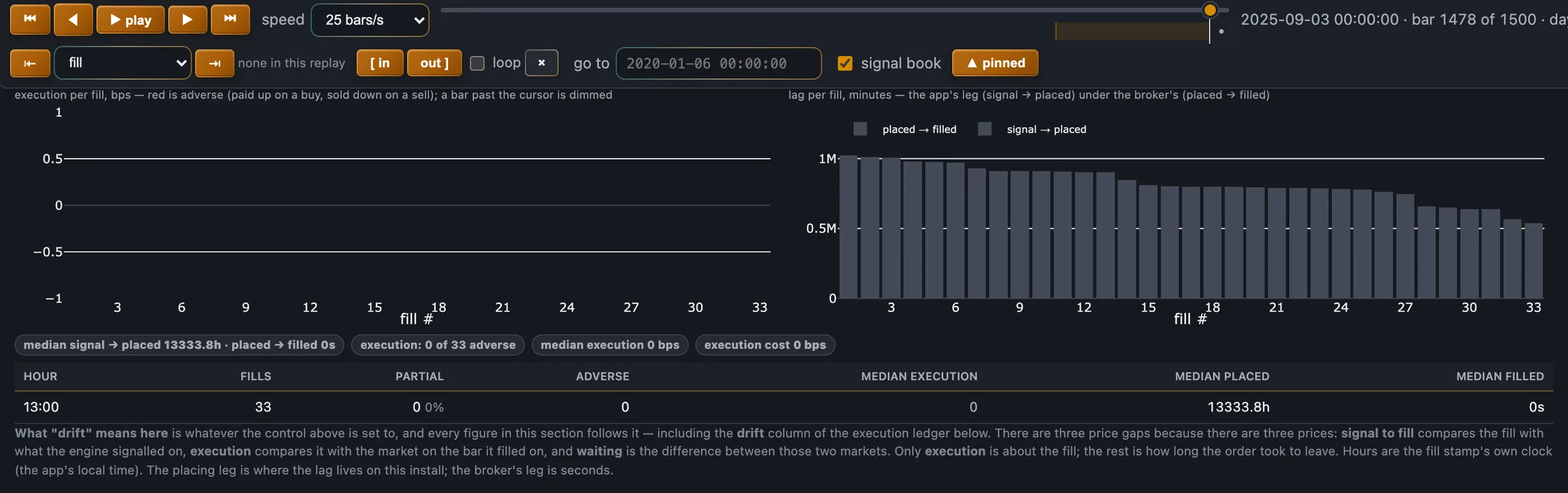
The time from a signal to a fill is split into the application's leg — from the signal to the order being placed — and the broker's leg, from placement to fill. They are shown stacked, never summed into one figure, because one figure blames the market for a delay the machine caused.
Guards against: tuning the wrong half of a delay.
Price drift on a named basisperformance
"Drift" is ambiguous: against the signal's price, the price when the order was placed, or the market on the bar it filled? The replay offers each as a named basis, defaults to execution — the fill against the market it executed into — and says that its two legs add up in money but not in basis points, rather than stacking two numbers that do not sum.
Guards against: charging a broker for time an order spent waiting inside the application.
The Vigil keeps watching after deploymentperformance
A promoted strategy can be deployed to forward paper evidence for a stated number of bars, and live evidence is refreshed on a cadence against one high-water mark — so a deterioration is a fact the system fires on, not a feeling somebody has.
Guards against: a strategy that stopped working while everyone was looking at the backtest that said it would.
Calibration and deviance measure the gap to the planperformance
Calibration compares what testing predicted with what happened; deviance reads the audit trail for every guard you overrode and measures, after the fact, whether overriding it helped. Neither writes anything, blocks anything or changes a deployment.
Guards against: learning nothing from the difference between the plan and the outcome.
Testing the tests
None of the above is worth much if the checks that guard it can pass for the wrong reason. The project runs 332 test suites, and the suite runner takes each one's exit code as its verdict — never its printed summary, which exists in six formats and would eventually be misread as a pass. The suites are themselves tested by mutation: a deliberate defect is written into the code a suite guards, and a suite that stays green is a suite that is not checking anything. And a surprising share of what is described on this page was found the same way — by rendering the page and looking at it while every check was green.
None of this makes trading safe. Every mechanism on this page reduces a specific, known failure mode; together they do not remove market risk, execution risk, data or connectivity failure, software defects, or the risk that a strategy which worked stops working — and no list of safeguards can. Nothing here is investment advice, a recommendation, a warranty, or a claim that these measures are sufficient for any purpose. Trading involves risk of loss.
A personal project. Not advice. Nothing for sale.
This site describes a personal engineering project, written and run by one person in their own time and published under the name Mithraeum Agora. There is no company behind it, no team and no other contributor. It is not a product and not a business. Nothing here is for sale — there is no account to open, nothing to buy, no subscription, no waiting list, and no service is being offered or solicited. Sending a message through the note form creates no customer, client or contractual relationship of any kind. The note form on the contact page is the way to reach me, and it is the only one.
Nothing on this site is investment advice, financial advice, tax advice, or a recommendation, solicitation or offer to buy or sell any security or financial instrument. I am not a financial adviser, a broker, an investment manager or a regulated firm, and nothing here should be relied on as though I were. If you are making decisions about money, take advice from someone qualified and regulated to give it.
Figures do appear on this site, inside screenshots, and none of them is a performance claim. Every one is a demonstration instance's own arithmetic over price series the application generated itself — synthetic data, with no real market behind it — shown to illustrate what the tools display. They are hypothetical and simulated: no capital was at risk, no orders were placed, and a result computed over history with the benefit of hindsight carries limitations that live trading does not forgive. Hypothetical results are not indicative of future returns, and past performance — real or simulated — predicts nothing.
No brokerage, market-data vendor or other company is named anywhere on this site, and where a name appeared inside a screenshot it has been redacted out of the image. Nothing here states or implies that any company is associated with this project, endorses it, sponsors it, supplies it or has reviewed it. None is, and none has.
What this site collects. Nothing, unless you write to me. There is no analytics, no tracking, no advertising, and nothing at all is loaded from another domain. If you use the note form it takes the name, address and message you type, stores them privately where only I can read them, and keeps them for up to a year before they are deleted — sooner if you ask, and you do not have to give a reason. Your IP address is not kept. One thing is stored on your own device: the colour theme you pick, remembered by your browser so the site does not change appearance every time you arrive. It is written only when you choose a theme, and it identifies nothing and nobody. The preference itself never leaves your browser, but the screenshots follow it, so the pictures your browser fetches from this site are the ones drawn in that palette. The contact page answers all of this in more detail.
Terms of use. This site is provided as is and as available, with no warranty of any kind, express or implied. It describes software under active development: anything here may be incomplete, out of date or simply wrong, and it may change or disappear without notice. Nothing on it is a contract, a term of service for any product, or a promise that anything described will be built, released or kept running. To the fullest extent the law allows, I accept no liability for any loss or damage arising from use of this site or from reliance on anything it says. Nothing here excludes or limits any liability that cannot lawfully be excluded or limited.
Trading involves risk of loss.