Identity and community
The Agora
The web service. It knows who you are and nothing about what you trade — that separation is enforced by the fact that it was never given a way to find out.
This page is the Agora's own tour: the community layer in screenshots, how signing in to the application works, and the two pieces of engineering worth describing properly. The shared strategy library — where members publish and adopt logic — has its own page beside this one. Where the Agora sits among the four programs, and what is allowed to cross between them, is drawn on Architecture.


Accounts and sign-in
Passwords stored as salted derivations, durable browser sessions, device tokens for the desktop application, and a single sign-on handshake redeemed server-to-server rather than through the browser.
The manual
Authored here and pulled by the application, with the bundled copy acting as an offline floor. One document is the source of truth and it keeps its own revision history.
Forum and library
Boards for discussion and a shared library of contributed material, with reputation grades, moderation and reporting.
Support
Conversations between a customer and me, with an optional diagnostic attachment the customer reviews in full before anything is sent.
What the community layer actually looks like
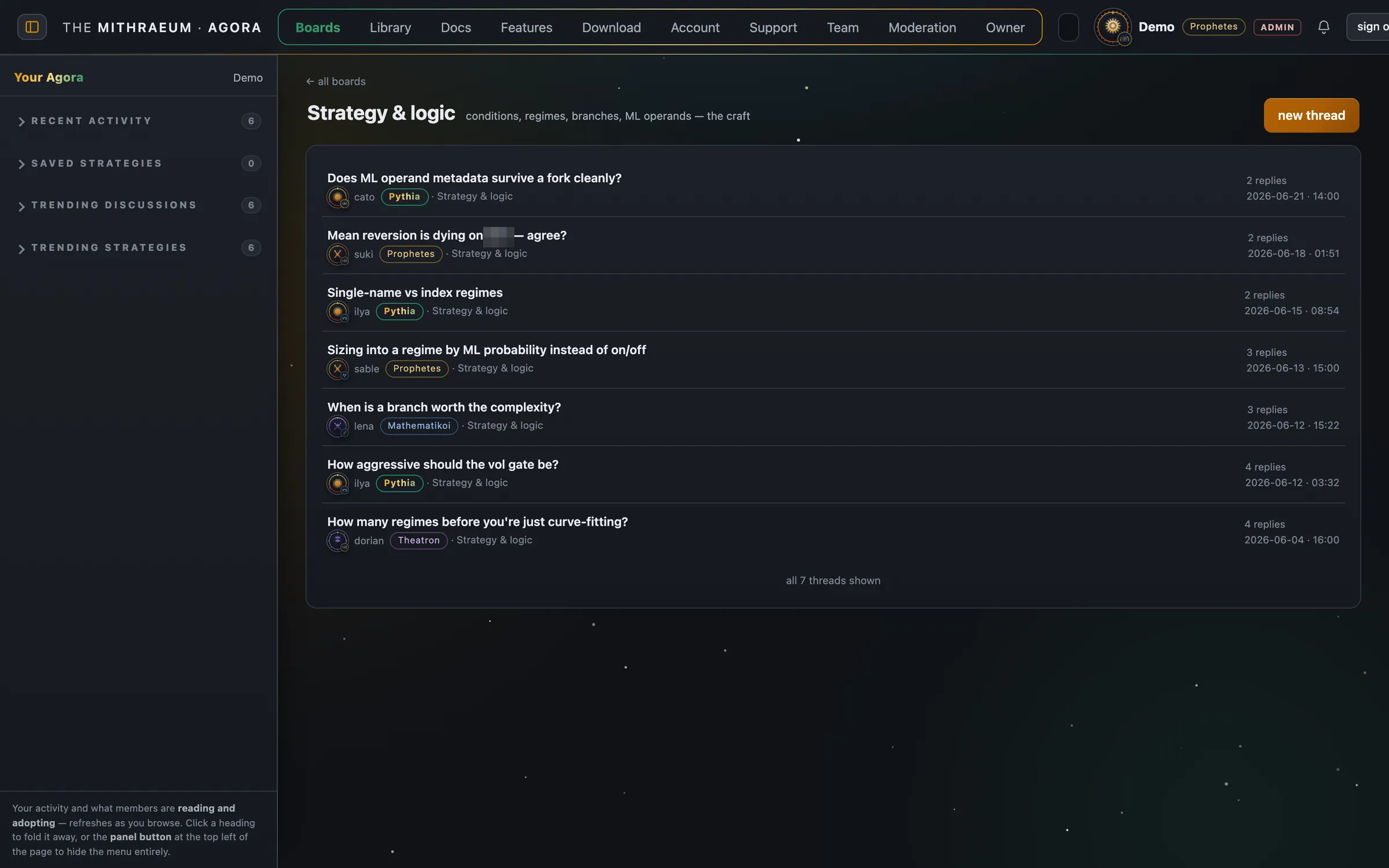
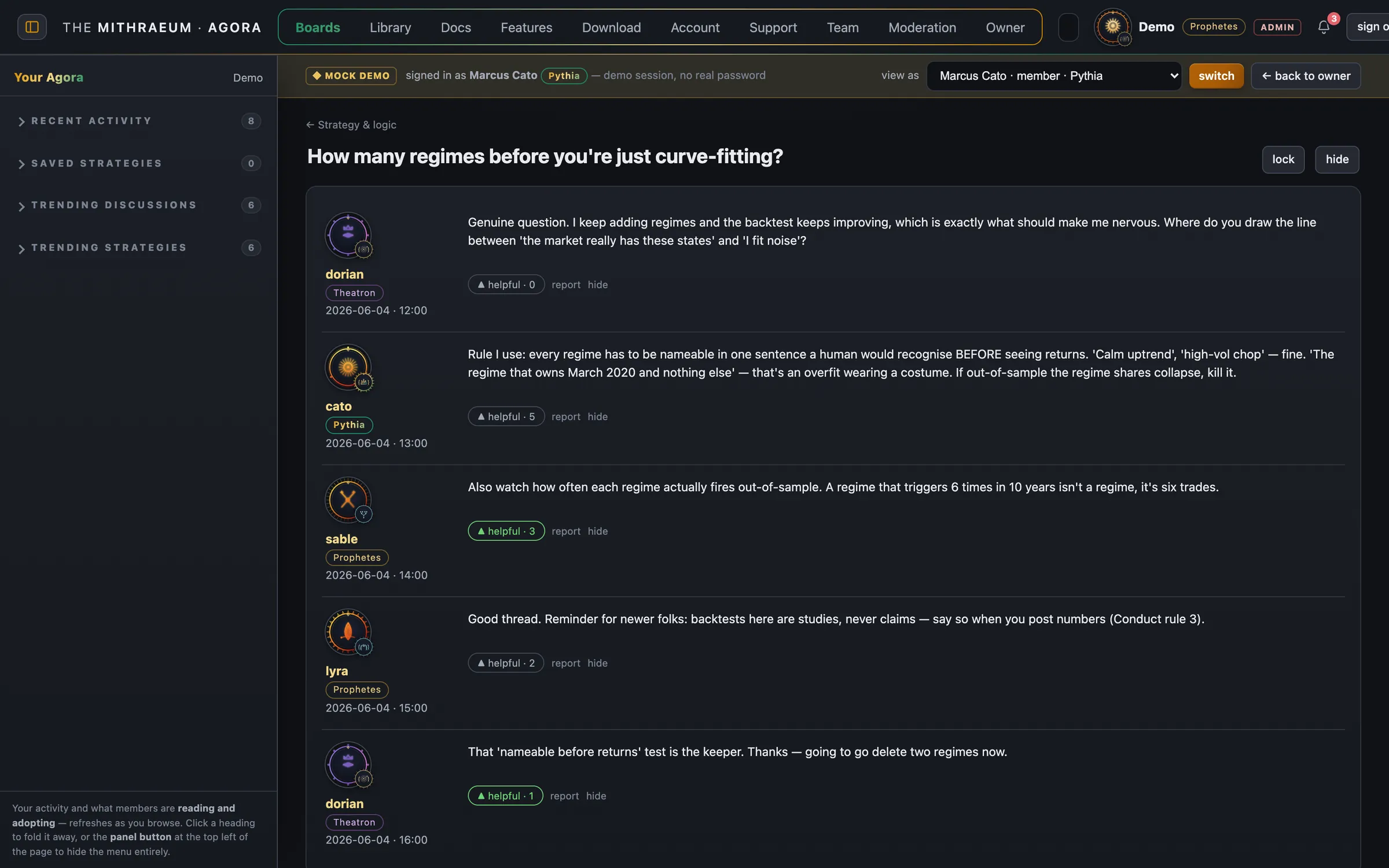
The frames below are from a demonstration instance carrying the project's seeded content — invented members, invented threads — captured in that instance — the thread viewed as one of those seeded personas, under the mock-demo banner the instance itself paints across the top. The menu's trending sections are folded: they carry the seeded roster's invented figures over real ticker names, which is the one combination this site never shows. Where figures do appear in these frames, they are the demonstration's own arithmetic over app-generated synthetic series, named as such on the card.


How signing in to the app works
The desktop application signs in through the Agora, but the browser is only ever a courier. The credential exchange that matters happens directly between the two programs.
Two things worth describing properly
Most of this service is ordinary. Two parts were not, and they are the parts I would show another engineer.
1 — The diagnostic attachment is an allowlist
When something goes wrong, it helps enormously to know what the application was doing. It helps not at all to know what anyone was trading. So a support bundle is assembled from a list of fields that were each deliberately declared — build identity, platform, configuration flags, counts of things, and error types with the code location that raised them.
- A field nobody declared is dropped, never sanitised. That is the difference between an allowlist and a denylist, and it is why adding something new to a bundle has to be a deliberate act rather than an accident of a data structure growing a field.
- Exception messages are discarded entirely. Python interpolates values into error text, so a message can contain the very thing you were trying not to collect. Only the type and the location survive, and there is no setting to change that.
- Redaction happens before transmission, on your machine. Filtering on arrival would be theatre — by then it has already arrived.
- You see the whole bundle as plain text before you decide whether to attach it.

2 — Closing an account actually closes it
Any customer can delete their own account themselves, re-authenticating with their password, with no blockers of any kind — no "contact support", no cooling-off, no retention hold. Their posts and contributions are destroyed rather than hidden. This turned out to be far more interesting to build than expected, for reasons that are entirely about correctness rather than privacy.
- The username is released immediately, which means somebody else can register it tomorrow. Every commercial record was keyed by username. A surviving row would therefore be inherited by a stranger — an active subscription, or a used-trial flag denying somebody a trial they were owed. That is a correctness bug before it is a privacy one, and it forced every account to carry a permanent opaque identifier that closed records are re-keyed onto.
- One anonymous row survives: an opaque id, a hash of the verified email address, whether a free trial had been used, and the open and close dates. No name, no address, no content. It exists because the once-per-person free trial otherwise becomes infinite — delete, register again, another trial, forever.
- The order of operations is the failure design. The account is verified and the record written before anything is destroyed. If the step that re-keys the commercial records fails, the whole closure aborts and nothing has been destroyed — because releasing a username while a subscription still answers to it is exactly the collision the whole scheme exists to prevent.
- A thread other people replied to survives, with the opening post tombstoned under a per-closure handle. Somebody else's reply is not yours to delete. Every closure gets its own handle rather than a shared "[deleted]", because one shared literal quietly merges every departed person into a single apparent person.
This site is descriptive, not contractual. Nothing here is a term of service, a privacy policy, a warranty or an offer. Where this page describes behaviour, it describes how the software is built, not a promise made to anyone. Nothing on this site is investment advice.
A personal project. Not advice. Nothing for sale.
This site describes a personal engineering project, written and run by one person in their own time and published under the name Mithraeum Agora. There is no company behind it, no team and no other contributor. It is not a product and not a business. Nothing here is for sale — there is no account to open, nothing to buy, no subscription, no waiting list, and no service is being offered or solicited. Sending a message through the note form creates no customer, client or contractual relationship of any kind. The note form on the contact page is the way to reach me, and it is the only one.
Nothing on this site is investment advice, financial advice, tax advice, or a recommendation, solicitation or offer to buy or sell any security or financial instrument. I am not a financial adviser, a broker, an investment manager or a regulated firm, and nothing here should be relied on as though I were. If you are making decisions about money, take advice from someone qualified and regulated to give it.
Figures do appear on this site, inside screenshots, and none of them is a performance claim. Every one is a demonstration instance's own arithmetic over price series the application generated itself — synthetic data, with no real market behind it — shown to illustrate what the tools display. They are hypothetical and simulated: no capital was at risk, no orders were placed, and a result computed over history with the benefit of hindsight carries limitations that live trading does not forgive. Hypothetical results are not indicative of future returns, and past performance — real or simulated — predicts nothing.
No brokerage, market-data vendor or other company is named anywhere on this site, and where a name appeared inside a screenshot it has been redacted out of the image. Nothing here states or implies that any company is associated with this project, endorses it, sponsors it, supplies it or has reviewed it. None is, and none has.
What this site collects. Nothing, unless you write to me. There is no analytics, no tracking, no advertising, and nothing at all is loaded from another domain. If you use the note form it takes the name, address and message you type, stores them privately where only I can read them, and keeps them for up to a year before they are deleted — sooner if you ask, and you do not have to give a reason. Your IP address is not kept. One thing is stored on your own device: the colour theme you pick, remembered by your browser so the site does not change appearance every time you arrive. It is written only when you choose a theme, and it identifies nothing and nobody. The preference itself never leaves your browser, but the screenshots follow it, so the pictures your browser fetches from this site are the ones drawn in that palette. The contact page answers all of this in more detail.
Terms of use. This site is provided as is and as available, with no warranty of any kind, express or implied. It describes software under active development: anything here may be incomplete, out of date or simply wrong, and it may change or disappear without notice. Nothing on it is a contract, a term of service for any product, or a promise that anything described will be built, released or kept running. To the fullest extent the law allows, I accept no liability for any loss or damage arising from use of this site or from reliance on anything it says. Nothing here excludes or limits any liability that cannot lawfully be excluded or limited.
Trading involves risk of loss.