The shared library
Strategy posts — logic that travels, and nothing else
Members publish strategies to a shared library as logic — the tree of conditions, regimes and indicator settings — and other members adopt that logic into their own application. What a strategy would have earned is deliberately not the thing being shared.
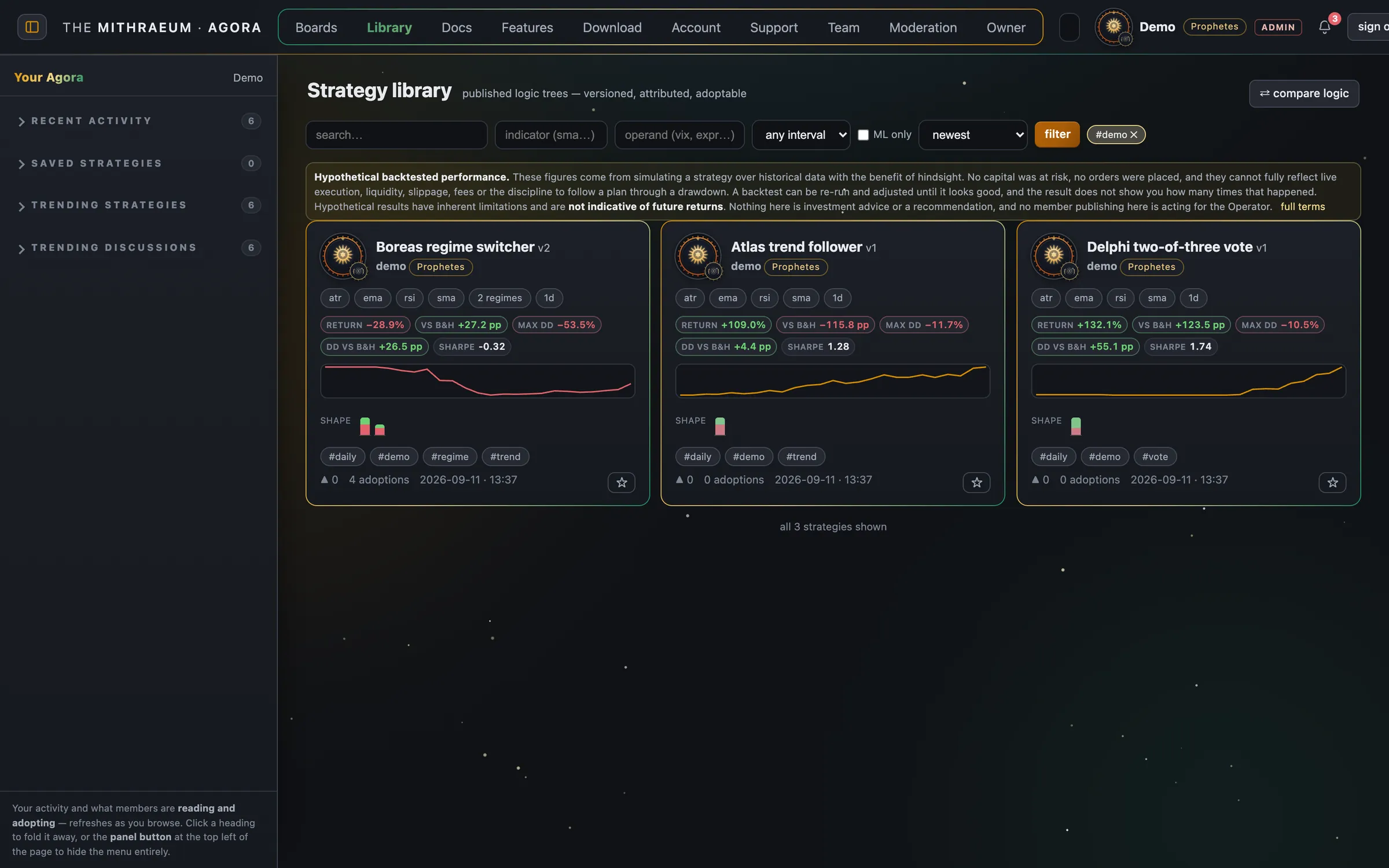
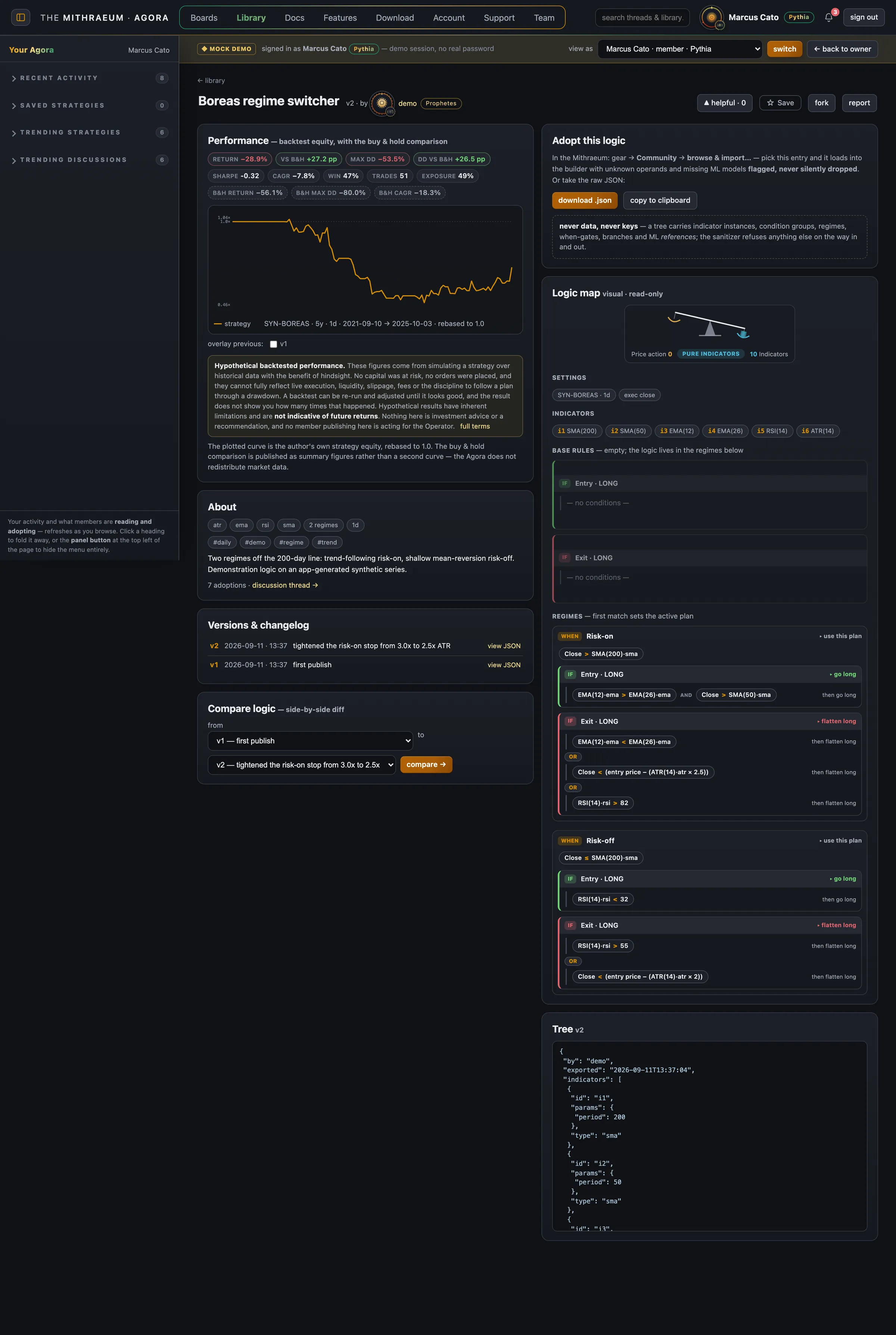
This page shows what a published strategy actually looks like; the rest of the community service — accounts, boards, support, sign-on — is toured on The Agora's own page. The frames below are capture slots for a walkthrough of specific posts on the demonstration instance — seeded content, invented members — and they fill in as those captures are taken.
Versions, with a changelog
A post carries its revision history: each version keeps its own tree, its own note about what changed, and can be viewed or diffed against any other. Revising a strategy is an edit with a record, not a replacement.
Forks, with attribution
Any member can fork a post into their own attributed entry — the copy links back to its origin, and the compare view can diff a fork against the strategy it came from. Lineage is visible, not implied.
Related logic
Each post lists others sharing its indicators and operand kinds — a way of finding neighbouring ideas that works precisely because composition, not performance, is what the library indexes.
Discussion attached
A post can open its own thread on the boards, so the argument about a strategy happens beside the strategy — with the same grades, votes and moderation as everywhere else.

What adoption actually does
Adopting a post loads its tree into the application's strategy builder — from the app's own community browser, or from the post's downloadable JSON. Two rules make that safe enough to be routine:
- The sanitiser is an allowlist, both directions. A published tree may carry indicator instances, condition groups, regimes, when-gates, branches and ML references — and nothing else. Anything unrecognised is refused on the way in and on the way out. Never market data, never credentials, never account details.
- Unknown pieces are flagged, never silently dropped. If an adopted tree names an operand this install does not recognise, or an ML reference with no local model behind it, the builder marks those conditions rather than quietly deleting them. ML models themselves never travel — you train your own and remap the flagged conditions.
About the frames on this page. Captures here come from a demonstration instance carrying seeded example content — invented members, invented strategies, and posts published from the demonstration application over app-generated synthetic series (the SYN-* names on the cards). Where a frame shows stat chips, an equity curve or any other figure, it is that demonstration's own arithmetic over those invented series, shown beneath the service's own hypothetical-results notice — not a result, not a track record. Nothing in the library or on this page is investment advice, a recommendation, or a claim about results.
A personal project. Not advice. Nothing for sale.
This site describes a personal engineering project, written and run by one person in their own time and published under the name Mithraeum Agora. There is no company behind it, no team and no other contributor. It is not a product and not a business. Nothing here is for sale — there is no account to open, nothing to buy, no subscription, no waiting list, and no service is being offered or solicited. Sending a message through the note form creates no customer, client or contractual relationship of any kind. The note form on the contact page is the way to reach me, and it is the only one.
Nothing on this site is investment advice, financial advice, tax advice, or a recommendation, solicitation or offer to buy or sell any security or financial instrument. I am not a financial adviser, a broker, an investment manager or a regulated firm, and nothing here should be relied on as though I were. If you are making decisions about money, take advice from someone qualified and regulated to give it.
Figures do appear on this site, inside screenshots, and none of them is a performance claim. Every one is a demonstration instance's own arithmetic over price series the application generated itself — synthetic data, with no real market behind it — shown to illustrate what the tools display. They are hypothetical and simulated: no capital was at risk, no orders were placed, and a result computed over history with the benefit of hindsight carries limitations that live trading does not forgive. Hypothetical results are not indicative of future returns, and past performance — real or simulated — predicts nothing.
No brokerage, market-data vendor or other company is named anywhere on this site, and where a name appeared inside a screenshot it has been redacted out of the image. Nothing here states or implies that any company is associated with this project, endorses it, sponsors it, supplies it or has reviewed it. None is, and none has.
What this site collects. Nothing, unless you write to me. There is no analytics, no tracking, no advertising, and nothing at all is loaded from another domain. If you use the note form it takes the name, address and message you type, stores them privately where only I can read them, and keeps them for up to a year before they are deleted — sooner if you ask, and you do not have to give a reason. Your IP address is not kept. One thing is stored on your own device: the colour theme you pick, remembered by your browser so the site does not change appearance every time you arrive. It is written only when you choose a theme, and it identifies nothing and nobody. The preference itself never leaves your browser, but the screenshots follow it, so the pictures your browser fetches from this site are the ones drawn in that palette. The contact page answers all of this in more detail.
Terms of use. This site is provided as is and as available, with no warranty of any kind, express or implied. It describes software under active development: anything here may be incomplete, out of date or simply wrong, and it may change or disappear without notice. Nothing on it is a contract, a term of service for any product, or a promise that anything described will be built, released or kept running. To the fullest extent the law allows, I accept no liability for any loss or damage arising from use of this site or from reliance on anything it says. Nothing here excludes or limits any liability that cannot lawfully be excluded or limited.
Trading involves risk of loss.